 Ages
Ages 


Possibly the closest experience to a British prep school that you can get here in Tokyo, with all the usual advantages that you can expect from a prep school education. Established as a feeder school to Rugby School Japan, this academically rigorous school with its strong emphasis on extra-curricular opportunities will put children in good stead for whatever comes next.

Why read our school review?
Unlike other websites, schools can't pay to be included in The Good Schools Guide. This means our review of this school is independent, critical and fair, and written with parents' best interests at heart.
Unlock to access

Overview
- Student numbers
- 324
- SEN provision
- Mainstream with SEN support
- Religion
- Non-denominational
- Fees
- JP¥ 2,890,000 - JP¥ 3,240,000

Head of school
Head of school
Claire Fletcher
Since founding in 2021, Claire Fletcher. At the school gates every morning in ‘rain, snow, hail or sun’ to welcome the children. Knows every single child, and not just their name. She is well-spoken and proper but also has an upbeat, optimistic

Entrance
School says it is ‘mildly selective’. A phonics assessment for prep 1 entry and the cognitive abilities test (CAT4) for prep 2 upwards plus a formal interview with the parents and another with the child. Head says she looks for parents who understand

Exit
Vast majority of the initial intakes moved on to Rugby School Japan (RSJ) – not surprising as Phoenix House was set up as its feeder prep school – but it’s not the only option. In Japan, pupils have moved to The British School Tokyo, Malvern College

Latest results
Academic progress is tracked against the English National Curriculum and school reports on whether a child is approaching, meeting or exceeding expectations.

Teaching & learning
Class sizes are set at a maximum of 16, but some are as small as 11, meaning teachers know their charges well and pupils are engaged. We saw children sitting smartly at tables, focused on their tasks or on the carpet, listening intently to the

Learning support & SEN
Teachers note where children are exceeding expectations (therefore needing to be challenged more) or have gaps. Intervention groups are then set up where teaching staff are timetabled to work with small groups of children to boost number work, mental

Language support
Like other international schools, the vast majority of pupils here speak at least one other language besides English. The curriculum presumes a good command of English; gaps in phonics, vocabulary or oracy are identified in the course of the usual

Arts & extracurricular
Pupils have music and art lessons with specialist teachers twice a week. Plenty of opportunity for pupils to present their work or perform at the winter and summer showcases or café concerts. We walked in on a prep 4 class preparing for their termly

Sport
Lacking an outdoor play area, school compensates by making full use of its huge indoor gym for indoor PE and other organised games during breaktimes. Children are bused to a sports ground 15 minutes away for outdoor PE every week. Additional sports

Ethos & heritage
School was conceived as a feeder prep school to the newly established Rugby School Japan, with which it shares common ownership and management. The aim is to replicate (as closely as is possible in Tokyo) the experience of a British prep school.

Pastoral care, inclusivity & discipline
Each child belongs to one of four houses. During house time every Friday, children take part in team building activities. House formals are a highlight in school calendar – once a year parents, pupils and staff dress up and sit down for a formal meal

Classroom & community
Currently slightly over half of the pupil population is ethnically Japanese but there is increasing diversity among new joiners.
Among parents, the Japanese tendency towards formality and reserve may mean it takes time to break the ice. We hear
- School year
- August – June, three terms
- School hours
- 8:30am – 3:30pm
- Student nationalities
- 38 per cent local and 62 per cent international
- Uniform requirements
- Yes

Money matters
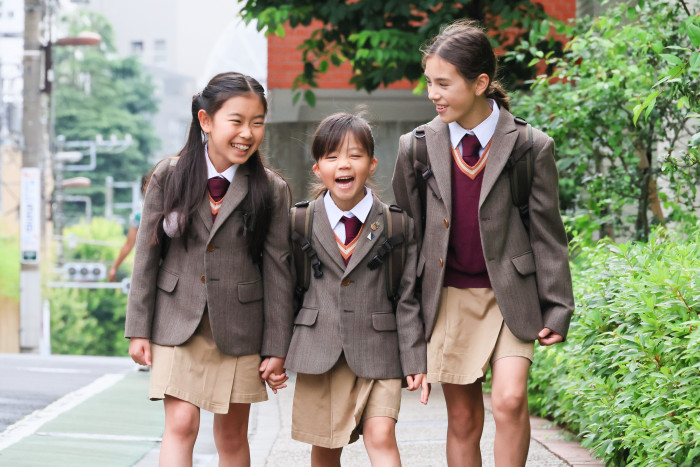
Be prepared – the tweed school blazer alone for your prep 1 child (compulsory, worn daily) costs more than £200. In defence, parents say the uniforms are high quality, smart and comfortable; children feel proud in the uniform which has a positive
- Annual fee range
- JP¥ 2,890,000 - JP¥ 3,240,000
- Fee information
- Application fee: JP¥ 40,000
Enrolment fee JP¥ 260,000
Optional additional activities, bus fees, lunch fees.
Annual development fee, mandatory for new pupils, optional for existing pupils JP¥ 300,000

The last word
Possibly the closest experience to a British prep school that you can get here in Tokyo, with all the usual advantages that you can expect from a prep school education. Established as a feeder school to Rugby School Japan, this academically rigorous

Accreditations, inspections & memberships
- Accreditations/Inspections
- Council of British International Schools (COBIS)
Independent Association of Prep Schools (IAPS)- Memberships
- COBIS, FOBISIA, IAPS