Best schools in Cape Town
Education in Cape Town
The international schools here might not be the biggest or best in the world; there are no famous names setting up satellite campuses. However, there is a great range of small to medium sized schools, with academic standards ranging from respectable to excellent – and while sport may not be played at the highest level, it will at least keep children active and healthy.
All the big schools attract international as well as local families, often with a 30/70 split respectively. Even the local students often have two passports, and parents either on an international career path or just wanting to keep their options open for the future.
The curriculum in South Africa
In and around the city, there are schools offering the International Baccalaureate (IB), UK/Cambridge, American, French and German curricula to a diverse student population.
Many families staying long term, as well as South Africans moving back from a stint overseas, opt for one of the local curriculum schools with an international contingent. Depending on the school, students graduate with either the Western Cape Education Department’s (WCED) leaving ‘matriculation’ qualification, called the National Senior Certificate (NCS), or the equivalent NCS issued by the private Independent Examinations Board (IEB). Both are known simply as ‘matric’, also the name given to the final year of school (grade 12), with the IEB considered the more demanding and robust of the two.
The academic year
One consideration when looking at schools is that the academic year runs from January to December, with the long holiday over Christmas (the South African summer), and only a couple of weeks off in June/July, when many international families want to head north to spend time with families and friends during their long summer break.
It’s a bigger problem for international families with older kids moving from one system to the other, especially with the two-year Cambridge IGCSE, A level and the IB diploma courses where children must either join halfway through a school year, missing some crucial learning, or repeat six months. Lycée Français du Cap and American International School of Cape Town (AISCT) have adopted the northern hemisphere’s school calendar, with some parents choosing them for this reason.
Also good to know is that the local school year runs to 43 weeks, spread over four terms, which can be a shock to those used to around 36-38 weeks of school elsewhere, though it can also be helpful for working parents. Even the independent schools follow a similar calendar.
Loadshedding
One note of caution: from time to time the country suffers load shedding - planned power cuts of two to four hours at a time on a rolling basis, often multiple times a day, to prevent the complete shutdown of the national grid. Caused by decades of underinvestment, combined with widespread corruption and organised theft of everything from coal destined for the power stations to the cables supposed to be carrying the electricity, it’s here to stay for the foreseeable future. Most schools have invested in a combination of generators, inverters and (increasingly) solar panels to prevent disruption, but it’s worth checking individually.
Choosing a school in Cape Town
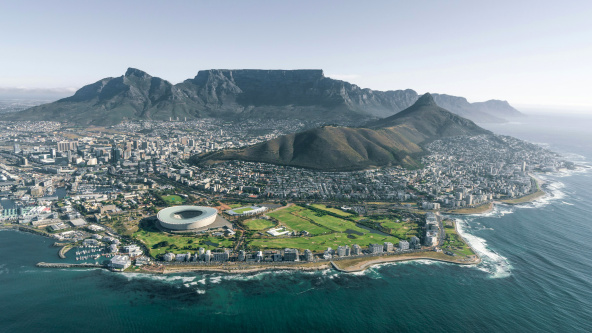
Although a smallish city, Table Mountain looms large, bang in the middle of Cape Town, meaning that in the rush hour traffic it can be quite a trek from one side to the other. With no safe public transport, apart from perhaps the MyCiTi bus along the Atlantic Seaboard for teenagers, and with children generally not allowed to walk or cycle on their own, they are dependent on their parents, an informal carpool or a private school bus. The school run, especially if combined with a commute to the office, becomes a crucial factor when considering where to live and send kids to school.
Boarding
While many of the single sex schools in town have boarding facilities, they are not set up for international termly boarders. They attract mostly local children, plus some from the rest of the country (and from neighbouring ones) who have family and friends visiting the city regularly, so do not necessarily stay in school at weekends. Out in the winelands, however, Bridge House School has European exchange students boarding and lays on termly airport shuttle runs. Somerset College provides the same, and has a few boarders from outside the continent, with plans to extend. American International School of Cape Town (AISCT) intends to build a boarding house on campus in the next few years, and Hout Bay International School is considering its options. With all boarding schools here, check the numbers staying in on weekends and the activity programmes on offer.
The Winelands
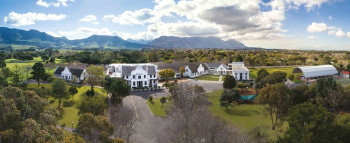
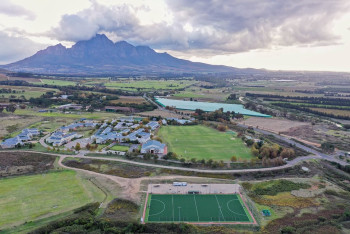
The beautiful Cape Winelands’ region (broadly covering Durbanville, Franschhoek, Stellenbosch, Somerset West, Paarl and including the huge Val de Vie lifestyle estate), long frequented by wine-tasting tourists, is now home to an increasing number of South African and international families able to work from home (or flexibly). It might be an hour or two into town, and no joy in rush hour, but high-flyers enjoy easy access (30-60 minutes) to Cape Town’s busy international airport east of the city centre, and there are plans afoot to develop Durbanville’s small airfield into a commercial Cape Winelands airport.
Top school choices here are Bridge House School outside Franschhoek (an IEB school with boarding), Somerset College with a choice of IEB or Cambridge A levels (also boarding), Curro Durbanville (new flagship school of the huge Curro Group, offering IEB), Helderberg International School (Cambridge A levels), Generation Schools Somerset West (currently phasing out the IEB in favour of Cambridge IGCSE and A levels) and Green School South Africa, sister school of the famous one in Bali.
Local schools
An alternative option in town is one of the many renowned local curriculum single-sex schools such as SACS (South African College School), Wynberg High Boys, Rondebosch Boys and Bishops Diocesan College (‘Bishops’) for boys, and Herschel Girls, Wynberg High Girls, Sans Souci and St Cyprian’s for girls. Some of these are public and some independent – the distinction is blurred as standards are similar and public schools, or at least those in wealthier areas, confusingly charge fees here.
These schools can be quite traditional, with knee-length socks, blazers and strict discipline, and they will probably require pupils to learn Afrikaans as a first additional language, though an exemption may be available for students arriving from grade 8 onwards. They generally have a great reputation for sport and amazing facilities, which attract international students wanting to play rugby, cricket, waterpolo and more at a high level. They are balanced by long-established Capetonian families, where successive generations attend the same school, akin to Eton or Harrow in the UK. Most of these schools have boarding houses, attracting pupils predominantly from elsewhere in South Africa and other sub-Saharan countries, as well as local pupils with busy schedules.
Special education needs in Cape Town
The schools all say that they cater for children with special educational needs on a case-by-case basis and will admit a child if they think they can provide the necessary support to allow them to thrive in their school. Some, like AISCT, have a clearly stated policy on their website detailing the five levels of support available; only level one (minimal support from the classroom teacher and learning support specialist) is included in fees. Most schools will allow and organise a one-on-one facilitator if required, paid for by the parents.
Schools with established ELL (English language learners) programmes will accept pupils without fluency in English (up to a specified grade) if they believe the child can thrive with the extra help provided.
Pre-schools, kindergarten and nurseries in Cape Town
Schooling in South Africa is not compulsory until the year a child turns 6 (grade R or 0), but many families start their children much younger than this, with pre-school classes often called 00, 000, and even 0000 (pronounced as ’quad nought’) for little ones turning 3.
Most schools, except Bishops and the German International School, accept children into their early years programme from age 2 or 3, with Reddam House even taking babies from 1-year-old, and HBIS accepting toddlers in nappies.
Private pre-schools
Another option is to choose from the plethora of private pre-schools dotted around the city, often run out of residential homes and catering for a handful of children. Here, personal recommendations are the best way, and if you don’t know anyone yet, local ‘expat’ Facebook groups can be a good source of information. Do try and visit several to find the best fit, and ensure that it’s properly registered with the Western Cape Government as an ‘early childhood development facility’.
Although some pre-schools include a reception class, don’t expect your child to start to learn to read. Unlike in the UK, phonics are not taught until grade 1 (age 6) in local schools, although children may start to recognise letters and numbers. This can be a barrier to families wanting their children to enter international schools from the local system at age 6 to 8, as their prospective classmates have been reading for several years already.