

 Ages
Ages 


If good things come in small packages, that’s certainly the case at St Hilda’s. Pupils of all capabilities thrive in this homely environment. One parent summed it up: ‘There’s nothing corporate about it. It sounds cliché, but it really does feel like a happy family.’

Why read our school review?
Unlike other websites, schools can't pay to be included in The Good Schools Guide. This means our review of this school is independent, critical and fair, and written with parents' best interests at heart.

Overview & data
- Pupil numbers
- 140 ·
- Religion
- None
- Fees
- £16,902 - £19,134 pa
- Local authority
- Hertfordshire County Council
- Area guides

Headteacher
Headmaster
Mr Daniel Sayers
Since January 2015, Dan Sayers, previously deputy head and head of English. Originally from Surrey, he trained at the University of Winchester before earning his stripes in state primary schools. In 2004, he transitioned to the independent sector, joining St Albans High School for Girls (STAHS) Prep for five years, where he was head of pastoral and year 6 lead. Describes himself as ‘a teacher at heart’ – currently teaching history and geography to year 6, as well as 11-plus interview prep.
Calm and gently spoken, he is described by pupils as ‘kind’, ‘friendly’, and ‘not scary’. Parents agree, telling us that ‘he isn’t a distant figurehead – he knows the girls really well.’ They say he is ‘always open to suggestions’ and has ‘brought in so many opportunities’ – notably more sport, theatre trips, musical instruments and external workshops that tie in with curriculum topics (we saw a Stonehenge workshop in action). He has also introduced a school minibus.
He says he aims to remain ‘custodian of the traditional values’ of the school, ‘whilst not losing sight of moving it forward’. No plans to follow in the footsteps of other local preps going co-ed, however. ‘We remain passionate about single-sex education; girls definitely do better away from the boys and challenge traditional stereotypes.’
Plays the piano (including in assembly), as well as enjoying flute and singing. ‘I’m a historian by trade, musician by heart.’ Lives close to school with his wife and six children, several of whom are also musical. ‘They’re a bit like the von Trapp family,’ one faculty member quipped. Three of his brood are also St Hilda’s girls (one currently at the school), giving him the inside scoop from a parent’s perspective.
No plans to follow in the footsteps of other local preps going co-ed: ‘We remain passionate about single-sex education; girls definitely do better away from the boys'

Entrance
One form entry, with an average of 18 pupils per class. Most join at pre-nursery (2+), nursery (3+) and reception on a first come, first served basis. From year 2, taster day including numeracy and literacy assessments ‘to identify any areas in which they may need support’. Spaces often available throughout. Girls only from pre-prep; co-ed before that.

Exit
At 11+, overwhelming majority to STAHS but some to Berkhamsted, Abbot’s Hill, Queenswood, Habs Girls and North London Collegiate. Local state options include St George’s, Roundwood and Sir John Lawes, but numbers ‘vary depending on the year’. Twelve scholarships in 2024.

Latest results
There are no results to show for this school. Find out more.

Learning support & SEN

Pupils

Money matters
- Fee information
- £16,902 - £19,134 pa

Our view
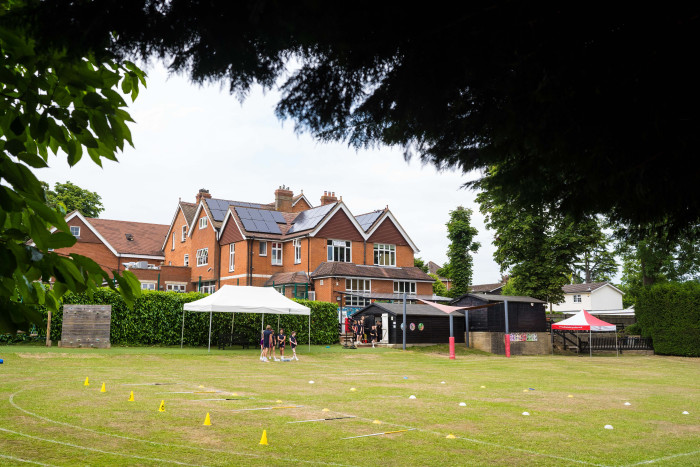
Located a hop, skip and latte away from Harpenden’s swanky high street, St Hilda’s feels like a family home, with its warm red-brick Victorian building, stained-glass front door and grandfather clock chiming in the hall. And with good reason: it was once the home of proprietor, Mary Piachaud, whose parents moved the school here in 1950. Mrs Piachaud’s daughter remains a teacher here, while several faculty members are either alumni or have seen their own daughters through the school. ‘Lots of girls have mums who went here,’ our guide told us. ‘My friend’s mum and grandma both came.’
The two-acre site may be petite compared to the vast rural grounds of some other local preps (one pupil complained that the narrow Victorian corridors ‘get too crowded’), but the layout is well-thought out and there are additional modern buildings to house pre-prep and reception, who share a compact but purposeful outside space with slides, mud kitchen and messy-play tuff trays. Early years teachers become familiar faces as they free-flow between the adjacent classrooms, so that by the time the children move into reception, ‘they aren’t starting school, just moving next door’. Transition is aided into year 1 too, where a roleplay corner welcomes youngsters, as well as ‘developing language and social skills’.
Pre-prep classrooms are cheerful, with self-portraits hanging from the ceilings, while wooden lift-lid desks in the prep classrooms hark back to days of old. But teaching styles are far from Victorian - year 4 were having great fun acting out the Twits and brainstorming adjectives for their own invented villains during a lively English lesson (‘Gruesome!’ ‘Slimy!’).
Regular forest school provides ‘freedom, release and the opportunity to be creative’. Reception girls skipped in bright-eyed and pink-cheeked from ‘foraging and getting mucky’. Weekly library visits too, with independent lunchtime access from year 3. A few grumbles from younger pupils that it gets ‘too busy and crowded’, but with the rocking chair by the fireplace, a squashy sofa and window seat overlooking the drive below, it’s easy to see why girls are reluctant to leave – we were tempted to crack open a novel and settle in ourselves. Dedicated spaces for STEM also popular.
The school is perceived by some as the ‘younger cousin’ of nearby heavyweight competitors, though parents we spoke to dismissed this as ‘snobbish’ – and it’s true that St Hilda’s holds its own academically despite its broad intake. Even in the early years, ‘busy mornings’ are spent developing literacy and maths skills, with afternoons spent on ‘more creative learning’. Parents say preparation for 11-plus is ‘brilliant’, and school makes it ‘as stress-free as possible’. Solid track record of destination schools too, although ‘maintaining that has been a consistent challenge over the years’, admits school – so current head has brought in a soft introduction of VR and NVR as early as year 2 and more formal prep from year 4. Too excessive? Parents don’t think so, with one commenting that ‘the school strikes a good balance’. MFL is impressive (Mrs Piachaud’s legacy), with French from nursery and Latin from year 3, plus an invitation-only German club for promising linguists in years 5 and 6.
Lots of specialist teaching, starting with French, PE and music from nursery. Computing and drama are added in year 1, then Latin, art and RE in year 3 – and all subjects by year 5. Small class sizes allow for differentiated learning, with teachers forming breakout groups based on pupils’ needs for each topic, eg those who need more support, and those who can handle more – as we saw for ourselves in a year 5 fractions lesson. ‘They don’t pigeonhole the girls - the school gives them the stretch and support they need to reach their full potential,’ approved a parent.
‘Additional needs are managed really well,’ feel parents. Seventeen per cent of pupils are on the SEN register (mostly dyslexia, autism and ADHD) although the SENCo estimates that 45 per cent have underlying additional needs. Many join from other settings specifically for this reason. ‘ My daughter’s enthusiasm for learning was beginning to wane in her previous state school, but I noticed an immediate change in her attitude to school after joining St Hilda’s,’ said one parent. We observed one-to-one support in lessons for some of these children, with group and individual booster sessions also available, plus a visiting external ed psych and OT when required (costs extra). Parents feel the small classes really help, as does the school’s willingness to adapt, eg one told us that although in prep years the girls change desks every term, her daughter (who doesn’t cope well with change) ‘was allowed to continue sitting next to her friend and she felt much more settled’.
Netball, tennis and hockey are the main sports, with parents pleased that school has ‘listened to feedback’ by recently adding cricket and a ski team. ‘We’ve also started playing a little bit of lacrosse,’ our guide told us. ‘The grounds are tiny,’ admitted a parent, ‘but they make the most of the space they have’. Courts have been recently updated and there’s a small athletics field with wooden tiered seating for alfresco drama and music performances in the summer. Swimming lessons take place in the 12-metre outdoor pool but ‘only in the summer – we go to an indoor pool at another school in the winter,’ said our guide, who must have noticed us shivering! Sportier local schools unlikely to quake in their boots at the sight of the recently acquired St Hilda’s minibus rolling up to tournaments, but for a school of smaller numbers, the teams do well – and, in any case, participation is the name of the game at St Hida’s. ‘That’s the beauty of a smaller school, everyone gets a chance to play,’ said a parent. Even at sports day, the atmosphere is one of camaraderie rather than cutthroat competition: ‘The girls are genuinely happy for their classmates when they win,’ said a parent.
Two-thirds of pupils learn a musical instrument, with lessons available from year 1. Those not keen or the piano, flute or violin can try their hand at the cornet, trombone or singing. Choirs and music groups for all ages, as well as an orchestra. Head’s aim is ‘to make musical opportunities as outward facing as possible’, so Harpenden residents are often treated to the dulcet tones of girls singing in their distinctive red blazers outside Waitrose or at the local church’s Christmas fayre.
Budding dramatists are well catered for with the pre-prep production, annual nativity and ‘highly anticipated’ year 6 play. Performances take place in the Seagull Studio, a soundproofed space with a good lighting and sound set-up, where we enjoyed watching the Showtime Singers (keen vocalists from years 3 and 4) rehearsing with gusto. An impressive three-quarters do LAMDA, available from year 2.
Corridors are plastered with art linking to term topics. Year 6 had an impressive display of Frida Kahlo portraits, and we enjoyed year 1’s whimsical fairy-tale pop-up board. No shortage of artistic talent, although we’d loved to have seen more of the pupils’ creations displayed in the art classroom too.
Clubs mainly sporty or musical, although year 6 have recently arranged a Rubix cube club – and they’re only chargeable if they are run externally. Day trips from year 3 (recently to the National Space Centre and Henry Moore Studios) and then residentials in years 4 and 5, with year 6 trip to Normandy via ferry.
Parents commend the ‘nurturing’ and ‘bespoke’ pastoral care. Pupils in years 5 and 6 are assigned a faculty member of their choice as a mentor to support them in school life and beyond, with a more general mentor system in younger years. Discipline issues are ‘rare’, which the pupils themselves help maintain, eg a ‘playground squad’ comprising of pupils in years 4-6 is on hand to resolve any minor squabbles.
Thumbs-up for the inclusive prefect system – every year 6 pupil is given a role (and the all-important badge for their blazer). House points awarded to those working towards six core values – positivity, independence, fearlessness, respect, kindness and resilience – that are emblazoned on the mural painted by pupils at the school’s entrance. ‘We celebrate one value each half-term,’ our guide explained. It seems to do the trick - pupils we met were polite and respectful yet self-assured, with one reception pupil confidently responding to our greeting, ‘I’m fine, thank you. How are you?'
The demographic reflects the local area, with around a quarter ethnic minorities and mostly dual income middle-class professionals who are grateful for the wraparound care (7.30am to 6pm). Many pupils live locally and walk or cycle. The furthest come from St Albans and Luton – those driven to school are greeted at the gates (often by the head) for the popular ‘drop and go’ system. Active PTA, with pupils enthusiastic about their ‘yummy baked treats’ on Fridays. Parent nights out and class Christmas drinks well attended, with one parent commenting that she ‘felt welcomed, even as a newcomer’.
St Hilda’s holds its own academically despite its broad intake. Even in the early years, ‘busy mornings’ are spent developing literacy and maths skills

The last word
If good things come in small packages, that’s certainly the case at St Hilda’s. Pupils of all capabilities thrive in this homely environment. One parent summed it up: ‘There’s nothing corporate about it. It sounds cliché, but it really does feel like a happy family.’