

 Ages
Ages 

A hyper-local, well-connected, aspirational and high-achieving comprehensive, which is run with tough love by a gung-ho teaching and leadership team.

Why read our school review?
Unlike other websites, schools can't pay to be included in The Good Schools Guide. This means our review of this school is independent, critical and fair, and written with parents' best interests at heart.


Overview & data
- Pupil numbers
- 1,330 ·
- Sixth form numbers
- 354 ·
- Religion
- None
- Local authority
- London Borough of Southwark

Headteacher
Head teacher
Mr Mark Pain
Since 2022, Mark Pain. Previously deputy head (academic), he led the school's successful curriculum and assessment for many years. He oversaw the teacher assessed grades process during the summer of 2021 and is involved with the Ambition Institute, developing school leaders to improve the outcomes and opportunities for disadvantaged pupils.

Entrance
Over six applicants for every year 7 place – total number up for grabs now up from 180 to 192, the extra 12 places prioritised for pupil premium students as part of school’s attempt to ‘avoid being a middle class enclave’. Looked-after children, then siblings, get first dibs, then it’s down to distance - catchment currently at around 1,000 metres (straight line) from the school, which means the majority of the intake is from privileged Dulwich Village, Herne Hill and East Dulwich, although turning right out of the school gates takes you to the social housing which is also incorporated. No feeders as such but largest cohorts from Dulwich Hamlet Junior School and Bessemer Grange.
Sixth form more inclusive than many: pupils must have five 9-4 grades including maths and English, with varying minimum grades for different A level subjects eg 7 in GCSE maths to study A level maths. ‘We haven’t had to use distance criteria at sixth-form yet, but it’s close.’
Prepare to feel squashed at the annual open days (in September for year 7 and November for the sixth form), there are often up to 2,000 attendees, although school does not encourage excessive applications to create fodder for their next press releases and will deter anyone living over 2,000 metres away from school gates.
- Open days
- September
Entry and exit data - year 7 entry (average 2020-2022)

Exit
About a third leave post-GCSE, swiftly replaced by eager external candidates. Majority to university – three-quarters to Russell Group or 1994 Group universities. Leeds, Manchester, Warwick and Bristol popular. Eight to Oxbridge in 2025, three medics (plus one from the previous year's cohort) and seven to art foundation courses. Three students headed to do degree apprenticeships.
% students progressing to higher education or training (2021 leavers)
What is this?
The proportion of 16-18 students that progressed to degrees, higher apprenticeships or other study at level 4 or above for at least 6 consecutive months in the 2 years after taking advanced level qualifications (level 3) at this school or college.

Latest results
In 2025, 54 per cent 9-7 at GCSE; 86 per cent 9-4 in both maths and English; 45 per cent A*/A at A level (78 per cent A*-B).
GCSE - % of pupils achieving grade 5 or above (A* to C) in English and maths GCSE (2024)
What is this?
This tells you the percentage of pupils who achieved grade 5 or above in English and maths GCSEs.
A levels or equivalent - Average points score (2024)
What is this?
These figures tell you the average grade and average points that pupils achieved in their academic qualifications. A maximum of 60 points are available for a grade A* at A level.

Teaching & learning
Strong on results, even stronger on progress. For value added, school is in the top 10 per cent of the country at GCSE and top one per cent at A level, an even harder nut to crack when it comes to raw advancement.
Secret weapon is believed to be the teachers – ‘the bread and butter of a school is the students’ five hours a day in the classroom – that has to be your starting point for success,’ says head, with parents reporting that ‘the teachers are so committed and always know exactly where your child is at’. Presumably the high calibre staff are at least in part attracted by the unusually leafy milieu for an inner city salary, but boy oh boy do they earn it. Teachers need not apply if they’re not prepared to give their all (many run clubs too), although few seem to burn out with many having clocked up over 10 years’ service (hard to believe as they appear so youthful). The school’s firm behaviour policy must be a further pull – not a whiff of disruption in the classrooms we observed – and it must also help that most parents buy into the school’s ethos which includes a big emphasis on the growth mindset that values effort over ability and being prepared to fail, ‘especially important in subjects like maths and modern languages where barriers come up,’ says head. (That said, a few students told us that although teachers always remind them to speak out if they don’t understand the lesson, ‘hardly anyone does because you’d feel stupid’.) Teaching styles are evidence-based and frequent testing ensures personalised monitoring.
Students can expect to work hard from the off and that includes a ton of homework, reckon pupils and parents (‘although they do try to make it interesting,’ said one parent). Setting in maths from year 7, and English and science from year 10 (everything else is mixed ability because school is concerned about the growing body of research that suggests sets are too often determined socio-economically). French or Spanish from year 7 and for those with an aptitude for languages, there’s also Mandarin from year 7 and Latin from year 8. Three-quarters take a language at GCSE. GCSE results shine brightest in the core subjects and history does particularly well too, along with art, drama and music; recent weak spot is ICT.
Some less desk-bound options such as PE and performing arts and a handful of BTECs are on offer – sport & leisure, business, engineering and ICT, with most success in business. For A levels, there are 28 subjects; around a third also do an EPQ. Sociology and psychology do phenomenally well year in year out and more recent strong performers include history, English and maths. Languages, having reached rock bottom in terms of A level take-up, are now on a slow incline (they even offer Latin joint with JAGS if there’s the demand). No gender split in maths and sciences.
Students’ eyes are kept constantly on the end game, with work experience and careers fairs attendance encouraged and over 200 trips a year on offer including to workplaces – all helping to raise aspirations, ‘particularly important for disadvantaged students,’ says head. The school has strong links with the City of London and large groups of students are taken to both Oxford and Cambridge. Careers advice includes mock interviews, CV writing workshops, presentation skills lectures galore. There must be a very impressive little black book under lock and key, with recent speakers including Cathy Newman, John Piennar and David Dean.
‘My son could so easily have not done much as he is a bit lazy, but they set him high expectations and he did brilliantly,’ raved a parent.
Presumably the high calibre staff are at least in part attracted by the unusually leafy milieu for an inner city salary, but boy oh boy do they earn it
- Qualifications taken in 2024
- A level
- BTEC
- EPQ
- GCSE

Learning support & SEN
Around 20 per cent of students have SEN - everything from dyslexia or dyspraxia to physical disabilities, autistic spectrum disorder or ADHD. Large learning support team of 23 staff, including specialist SEN teachers, higher level teaching assistants and learning support assistants, support students in mainstream classes but may also be able to offer small group withdrawals, extra literacy and maths intervention sessions, touch-typing, handwriting and reading clubs and input from a range of external agencies. ‘They have great interventions,’ one dyslexic pupil told us, while a parent told us, ‘they are amazing – my son would lose his head if it wasn’t screwed on and right from the start of year 7, they have helped him,’ although some parents feel SEN staff should be present at parents’ evenings. For disadvantaged students, interventions include half-term revision programmes, mentoring, online tutoring and space to revise in school for those where there’s nowhere to work at home.

Arts & extracurricular
Over 400 students take part in an after-school sports club every week, eg American football, cycling and rowing. ‘If you suggest a club in a new sport, they almost always find a way,’ enthused one. Other clubs include young historians, ukulele and study skills – and most recently a pupil-led climate change society that has introduced meat-free Mondays.
Speakers in the corridor of the music department (a nice touch) were blasting out the students’ steel band when we visited. More than 250 learn a variety of 15 different musical instruments up to grade 8, with some lessons significantly subsidised and many trying an instrument for the first time. ‘I know of one child who couldn’t play anything when she joined and now plays the saxophone at the Guildhall,’ said a parent. There are 15 music groups ranging from whole school orchestra to string ensembles. Past students have gained places at the Royal Academy of Music.
Students are understandably proud of their large, purpose-built, blackened-out drama studios and flexible theatre space, with all studying drama weekly until year 10, when decent numbers going onto GCSE and some to A level. Whole-school theatre performance – recently Grease and Guys & Dolls – produced every other year and eagerly anticipated, with more serious performances (separately) from key stage 3, 4 and 5 (eg The Caucasian Chalk Circle, Grimm’s Tales) taking place in the in-between years.
Shame there’s not more art on display around the school – there’s clearly some talent, judging from the (again disappointingly meagre) displays in the three-strong studio art department. We saw a real mix of teaching styles – straight backs, pencils poised at the ready among silent year 7s through to laid-back A level students, chatting and painting with the radio on. London galleries are frequented and facilities include kiln, dark room, screen printing and Mac suite. DT suite inspiring – we loved the row of student-made skateboards on the wall.
A leading school for DofE bronze – compulsory for all year 9s (although some don’t complete it); good numbers for silver and gold too. Around 200 day and residential trips every year – London Symphony Orchestra, Science Museum and a London art gallery, and that’s just for year 7, while all year 8s go on an activity week, usually in Dorset. Costs are half-price for those who need it.
‘I know of one child who couldn’t play anything when she joined and now plays the saxophone at the Guildhall,’ said a parent

Sport
‘Limited facilities’ are considered by parents to be something of a setback to sport, and it’s true that the school appears rather boxed in by houses and plentiful sports ground of the neighbouring girls’ school (JAGS). But students now use the JAGS swimming pool (and possibly soon their playing fields) and a playing field a five-minute walk away. The indoor sports hall is large, plus there is an on-site floodlit netball court, ball-court and Astroturf.
Football, cricket and athletics are the main sports – with girls and boys taught separately – and the teams for all three do well in fixtures, especially cricket where school is on an equal footing with the local private schools. Three ex-students are GB cyclists. ‘But it’s definitely not just about winning – they encourage you to enjoy sport for sport’s sake,’ said a student, with rugby, netball, volleyball, basketball and trampolining also on the menu, among others.

Ethos & heritage
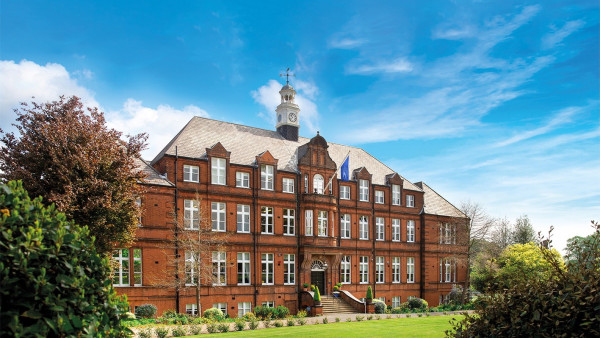
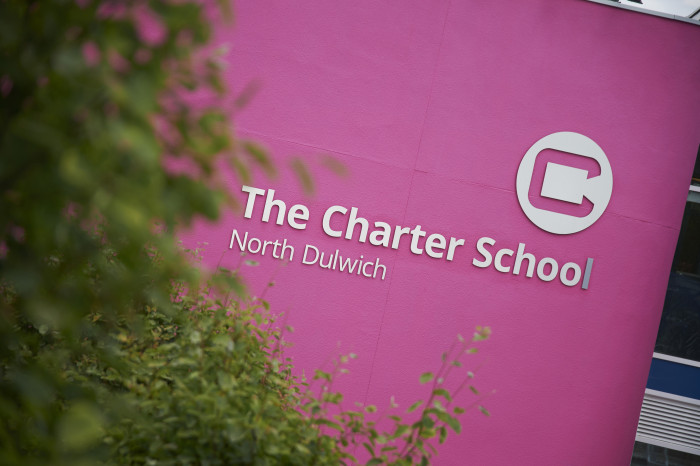
Turn right out of North Dulwich station and walk a few strides (we did so beside gaggles of Charter students heading into school, all with infectious chirpiness) and you’re there. So vast is the fuchsia pink wall that greets you the other side of the gate that it’s easy not to notice anything else. But there are three buildings in total – the original 1960s building belonging to the defunct William Penn School, plus two new ones built when the school opened in 2000 following a concerted campaign from parents in an area dominated by independent schools, but without a good state option. Savvy parents, and even savvier estate agents, realise that they have something of a find on their doorstep - Ofsted has rated it outstanding twice, most recently propelling it to a world class school.
The main reception area is huge – a good job as it has to act as something of a holding pen for the hordes of students caught in the morning bottleneck of getting to their classrooms. Receptionists must surely breathe a communal sigh of relief at the final swing of the door, such is the calm that follows. Everywhere is light and functional but now looking more than a little frayed around the edges, both inside and out.
And if you think the morning rush is noisy, try walking through the corridors between lessons. We saw animated children giggling, shouting and running – one boy tripped another up (done and taken in good humour, it seemed). Yet once lessons had commenced the atmosphere was so quiet, calm and industrious that we wondered if we’d imagined it.
All agree it’s a family school, in many ways literally - a third of every year group has school siblings. Strong pupil, parent and staff voice, with high numbers participating in the anonymous annual survey. Food ‘not exactly amazing, but ok for school dinners,’ reckoned a student.
The Charter School East Dulwich opened in 2016.
Founded in
Strong pupil, parent and staff voice, with high numbers participating in the anonymous annual survey

Pastoral care, inclusivity & discipline
Relatively relaxed uniform – polo shirts and jumpers, no ties or blazers – belies the school’s culture of high expectations and no-nonsense attitude to discipline. This is a strict school which the head claims creates freedom for good behaviour. ‘The rules are mostly fair and consistent,’ a student felt, although nobody (parents included) seems to like the fact that if you’re caught with a mobile phone, it’s confiscated for a week. Another told how her friend’s hat was taken away, yet to be returned – ‘I know the rule is no accessories, but it’s a hat!’ No piercings other than one pair of ear studs; no hoodies or outlandish hair colours.
Warning cards and tiered detention system nip minor misdemeanours in the bud and for more serious offences there are internal exclusions or even fixed-term (around 15 a term) or final exclusions (one or two a year; four the year we visited). ‘I am always very reluctant,’ reports head, who says the emphasis is more generally on inclusion and working with pupils to find a way back to contributing positively. School is vigilant about bullying, including of a homophobic or racist nature; one student told us, ‘My friend was bullied but the school dealt with it really quickly – they were great.’
Sanctions are well balanced with a caring ethos and positive rewards, with parents calling the pastoral care ‘amazing’. We noted jokes swapped between staff and students and there’s both a tutor system and house system - house points are handed out for good behaviour and lead to an email to parents from head of year. There are two school counsellors and year 11 mentors for year 7s. Staff too are mentored. Nobody shies away from talking about mental health, with specific projects around eg emotional wellbeing, growing up as a man and identifying particular needs.

Pupils & parents
‘A true community school,’ say parents. Diversity is celebrated – ‘everyone mixes together, no cliques’. Just over half are white British, with black British African as the second largest group (11 per cent of pupils). Although one of the most middle-class schools in the area, the parents come from all walks of life and more than 20 per cent of students are pupil premium. Surprisingly few EAL students - while many are bilingual, over 90 per cent have English as their first language. Pupils we met were relaxed, unguarded and easy to chat to but somehow lacked the pride in their school we’d expected.
Jaw-droppingly effective PTA recently raised £60k via a single event – the ingenious ‘Secret Charter’, which involved a blind auction of over 500 original art postcards, some (and here’s where the serious spondoolies came in) by the likes of Tracey Emin, Jeremy Corbyn, Hugh Grant and Jo Brand.
Surprisingly few EAL students - while many are bilingual, over 90 per cent have English as their first language

The last word
A hyper-local, well-connected, aspirational and high-achieving comprehensive, which is run with tough love by a gung-ho teaching and leadership team.

Inspection reports
Ofsted reports
Full inspection: Outstanding
You can read full reports on the Ofsted website
| Personal development | Outstanding |
|---|---|
| Quality of education | Outstanding |
| Behaviour and attitudes | Outstanding |
| Leadership and management | Outstanding |
| Sixth form provision | Outstanding |