

 Ages
Ages 


Near the Norfolk coast, this thriving, happy school with a reputation for encouraging individuality, will suit entire families. Renowned for inspiring creativity, this is a school where sport is just as successful and many are drawn to the flexible sixth form offer. Friendships flourish in a strong house system and excellent leadership inspires confidence. The future looks rosy.

Why read our school review?
Unlike other websites, schools can't pay to be included in The Good Schools Guide. This means our review of this school is independent, critical and fair, and written with parents' best interests at heart.

Overview & data
- Pupil numbers
- 537 ·
- Sixth form numbers
- 237 ·
- Offers boarding
- Yes ·
- Religion
- C of E
- Fees
- Day £25,950 - £26,130; Boarding £36, 360 -50,160 pa
- Local authority
- Norfolk County Council
- Linked schools

Headteacher
Headmaster
Mr Douglas Robb
Since 2014, Douglas Robb (MA), previously head of Oswestry School. After Edinburgh University (politics), he moved to Cambridge to do his MEd and followed that up with a spell of teaching in Zimbabwe and at Fettes College. Confirmed in his choice of career by this experience, he taught at Loughborough Grammar School then moved to Oundle, where he spent ten ‘very happy years’ teaching politics and economics and as a housemaster.
He is both genial and sharp witted, a fast talker and just the kind of person to sit next to in meetings (or anywhere) for informed, enjoyable company. He is a popular figure with pupils and parents. ‘He knows who we all are. You feel comfortable around him,’ said one pupil, and another, ‘He remembers conversations we have had, I always feel he knows us.’ ‘If you want to talk through something important, he’ll make the time to sit down and discuss it properly,’ said one parent and all agree he is ‘the same behind the scenes as he is in public. Quite forthright!’
His informality strikes a contrast with the setting of his ‘study’, a massive, portrait-lined room which includes a table to seat at least forty plus several sofas – with space to spare. He is impressed by the commitment of parents: ‘They often stay in AirBnBs to see their children over the weekend. They want more engagement with the school.’ Thinks the school’s popularity is attributable to the excellence of the teaching – ‘staff really make the commitment’ – and to the flexibility of the curriculum, particularly in the sixth form. ‘Over half do the IB – pupils can do a combination of courses.’ Thinks it works for whole families with different interests, talents and abilities.
Finances are healthy (‘We are sitting well in the water’), and a number of capital projects have all been completed under his leadership, but he is very aware of the pressures all schools are under. Has trenchant views on school leadership: ‘You’ve got to like the school you choose to lead. Too many heads use schools for their own career progression.’
He is married to Lucinda and they have three children who have all been at Gresham’s, though two have moved on. The family dog, Ziggy, is in school daily with his master, whose off-duty time is spent enjoying the north Norfolk countryside and social life and following a lifelong interest in rugby. Likes skiing and believes in ‘proper holidays’.
His informality strikes a contrast with the setting of his ‘study’, a massive, portrait-lined room which includes a table to seat at least forty plus several sofas

Entrance
Roughly 50 per cent of year 9 intake come up from Gresham’s Prep, the others from a mixture of day and boarding preps across the region and a sprinkling from the maintained sector. An assessment day is held for potential year 9s (including those from the prep) in the Lent term preceding a September admission. Tests in English and maths, verbal and non-verbal reasoning, plus reports and references.
For the sixth form, a minimum of six GCSEs at grade 6, at least a grade 4 in maths and English and a 6 for subjects to be studied, plus a report from current school and an interview. Around thirty pupils join the sixth form from elsewhere. Admission to higher forms is normally limited to those (usually international pupils) wishing to take the one-year GCSE programme. In exceptional circumstances a place may be deferred for a year, as in the case of one of our tour guides: ‘My family were relocated abroad for a year so I came in year 10.’

Exit
Post GCSE, great majority move on to the sixth form, including many of the one-year GCSE pupils. Roughly 15 per cent leave at this stage for pastures new, often for a sixth form college, occasionally another school. Post A level/IB, many go to universities such as Edinburgh, London (Imperial, King’s and UCL), Durham, Bristol. Three to Oxbridge in 2025, and a significant cohort to specialist colleges such as the Slade, the Courtauld, St Martin’s School of Art, Leeds Conservatoire and the Royal Academy.

Latest results
In 2025, 56 per cent 9-7 at GCSE; 44 per cent A*/A at A level. IB average 37. BTEC 62 per cent with distinction.
A levels or equivalent - Average points score (2024)
What is this?
These figures tell you the average grade and average points that pupils achieved in their academic qualifications. A maximum of 60 points are available for a grade A* at A level.

Teaching & learning
The work vibe is evident, whether it’s collaborative learning in the classroom or seeing how focused pupils are in the various study areas and libraries. Independence of thought and study is developed and encouraged as the ultimate goal of education with exam success seen as a consequence rather than a goal in itself. Several recent appointments have helped chivvy changes to the curriculum such as the greater use of BTECs alongside A levels and the IB in the sixth form.
Staff are extremely committed; ‘easy to contact if you have a query about your child,’ was a comment we heard several times. Giving pupils individual time with a mentor to discuss the progress of their work was singled out for comment: ‘I learnt how to prioritise my work. The guidance was really important.’ Smallish classes (under 24) with setting for maths, English and sciences from year 9. Languages on offer include French, German and Spanish, from which pupils select two to study (Latin is an option) and all pupils must take at least one among the customary 10 for GCSE. All pupils study the three sciences with the decision about taking the double award or the three individual GCSEs being taken in collaboration with the science department. All pupils make a choice of four options from a list that includes history, 3D design, music, religious studies, drama, computer science, plus several languages (if not already taken as part of the core).
Independence of thought and study is developed and encouraged as the ultimate goal of education with exam success seen as a consequence rather than a goal in itself
- Qualifications taken in 2024
- A level
- BTEC
- GCSE
- IB

Sixth form
Over half the cohort opt for the IB. ‘It offers a greater breadth of study,’ said a pupil. It is especially popular with international pupils, for obvious reasons. A levels and the BTEC or a combination are also possible and increasingly popular. ‘The BTEC is a flexible programme and particularly suits creative and performance subjects,’ say staff. Three A levels (four occasionally) plus an extended essay, but ‘Whatever a pupil wants to study, we try to make it work,’ says the school. We heard of an arrangement for one pupil to study Russian and Dutch via an online course for the IB. BTECs are currently being offered in agriculture, digital music production, drama and theatre studies and sport. Pupils receive plenty of guidance on choosing the right study path and academic mentors provide support throughout the sixth form. The school has a full-time careers advisor who arranges enrichment talks as well as advising on future training, apprenticeships and university courses. Pupils are free to arrange their own appointments.
The sixth form day house, Arkell, has its own common room with comfy sofas, a small kitchen and quiet study areas. There are also various specially designated areas for sixth formers to study quietly in the Dyson building or library and to work more collaboratively in TIGS café. In the boarding houses, sixth formers have their own rooms and share their own kitchen. We met five girls, the picture of contentment, drinking coffee on a sofa in their kitchen towards the end of lunchtime. Dress code for the school day is a suit with either a skirt or trousers, with own clothes for evenings. Social life is vibrant, themed evenings and formal dances are regular weekend events and Dave’s Bar is open once a week (‘it’s a good place to mix’). Alcohol is allowed with food for over-18s. Pupils have access to the local town during the week and at weekends, with sixth formers having more freedom than younger years.
Sixth formers have their own rooms and share their own kitchen. We met five girls, the picture of contentment, drinking coffee on a sofa in their kitchen

Learning support & SEN
The learning support department is based in the Reith building, a series of sunny rooms opening off a large central space, with desks for organised prep and other group work. The specialist staff of three full and three part time, plus two assistants, support pupils with a variety of difficulties, often dyslexia, dyscalculia and those on the milder end of the autism spectrum. Roughly a fifth of all pupils receive some kind of help and six pupils have an EHCP. For those who need it, help is given in individual lessons in the department: ‘We use odd corners of the timetable to fit lessons in, during tutor time or the long lunch break, for instance. We avoid withdrawal from the mainstream curriculum.’ Staff are very approachable – ‘Pupils often call in to see us. Perhaps they need a quiet moment or a bit of encouragement with a piece of work’ – and the department runs organised prep for any pupils known to them, which is extremely popular. All pupils are screened on entry to the school and problems are quickly picked up then or by staff who pass on any concerns.
Arts & extracurricular
Outstanding facilities for music, drama and art. The Britten building (named in honour of the composer, a former pupil) offers space for formal concerts in the imposing Fishmongers’ Hall, informal recitals, practice rooms and a recording and editing suite. The school has its own record label, Strathmore Music, and edits and records performances for the Gresham’s YouTube channel and Spotify. It’s a Steinway school so pupils perform and practise on top-of-the-range instruments (there are 16 in total) and we had the spine-tingling experience of hearing one of Liszt’s piano concertos being practised. Hundreds of lessons on all sorts of instruments – over a third of pupils learn one, many more than one, and there are opportunities galore to play and perform in every imaginable ensemble, quartet, orchestra and band. There is a big concert each year at nearby Binham Priory, a piano festival, the Christmas Tree festival concert and a number of low-key events such as ‘music and munch’. A level music tech, IB music and BTEC digital music production are popular courses and several pupils leave each year for conservatoires. Staff encourage critical use of AI: ‘They need to develop the necessary skills to differentiate and be versatile.’
The Auden Theatre, with its 300-seater auditorium, is the centre for all things dramatic, whether LAMDA classes, a Shakespeare film competition, or the next big musical, Les Misérables. ‘We find the IB theatre course, or the BTEC in performing arts are increasingly the choices for pupils, especially those wishing to go on to drama schools, which all admit via audition.’ There is plenty to do for those who don’t wish to tread the boards, such as stage management and lighting, and the highly professional foyer, dressing rooms and backstage would encourage anyone to get involved in some aspect or other. The Theatre in the Woods stages outdoor performances such as the recent Fright Night.
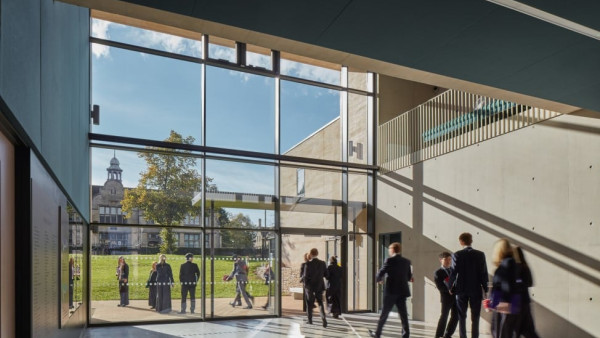
Art is just one of the creative forces in the world class Dyson building, where all the STEAM subjects have their home. The building, named and opened by alumnus and inventor Sir James Dyson in honour of his father, a teacher at Gresham’s, gives pupils the opportunity to work in and experience a space that is itself a work of extraordinary engineering and beauty. A variety of courses can be followed – fine art, 3D design, graphic communication and photography – and results are excellent. Staff encourage pupils to be adventurous. ‘They shouldn’t be thinking, I am making a chair, but see what comes out of the imaginative use of materials.’ The results are there for all to see and it is hard to imagine anyone not being inspired in one direction or another by their display.
A programme of clubs and societies (known as ‘gaps’) runs three times a week, and in addition to things creative there’s plenty for the outdoorsy. CCF is extremely popular (over 90 per cent do it) with an on-site parade ground and field days twice a year. The school has its own armed forces style obstacle course with a 220-metre zipwire and high ropes, abseiling facilities and a 25-metre climbing tower. Majority of pupils complete bronze and silver DofE and many achieve gold. Several successful environmental initiatives (the school is a holder of the Eco-Schools Green Flag gold award) and the school is completely powered by solar renewables.
The school has its own record label, Strathmore Music, and edits and records performances for the Gresham’s YouTube channel and Spotify

Sport
Two afternoons a week devoted to sport, and rugby, cricket, football, hockey and netball are all played to a high standard with multiple teams and long fixtures lists each Saturday. ‘We like everyone to at least try all the team games in year 9,’ say staff, ‘but if it’s really not for them there are other options.’ These include cross-country running, swimming, shooting (school has its own range), golf, squash, tennis and riding. A certain hardiness is required to actually relish a wintry afternoon’s sport in north Norfolk but many do; ‘The rugby pitch is my son’s happy place,’ said a parent and matches are well supported by families, staff and pupils. The attractive cricket ground is a magnet in summer. The talented athlete programme picks up the gifted players for bespoke training – the gym is open for supervised sessions at 6.30am – and professional athletes work on individual programmes, including those of rehabilitation after injury.

Boarders
Seven boarding houses, all recently updated, are scattered about the campus – four for boys and three for girls. House staff live in. ‘I see the house as an extension of my own home,’ said one houseparent. Houses are attractively decorated with large photo montages of pupils enjoying myriad activities on walls and there are views from most windows of the grounds and nearby woods. Mostly two to five bedded rooms with shared bathrooms; upper sixth have own rooms. Houses have their own style but all have study areas and common rooms that include comfy sofas, table tennis, air hockey and television, plus a large, well-equipped kitchen to make snacks and full-blown meals at weekends. ‘Cookery is extremely popular,’ say house staff and kitchens are often the hub of the house, where pupils return at break times and after school. No rules banning fraternisation between houses, at least until 9pm, and day pupils have their own desks in the house and integrate well. Some pupils return home for Saturday nights but many stay in for the regular socials (a silent disco planned for the week we visited). Sunday has a more relaxed vibe: late brunch, then a variety of occupations including trips to Norwich, a boarders’ run, film nights and twilight swims.

Ethos & heritage
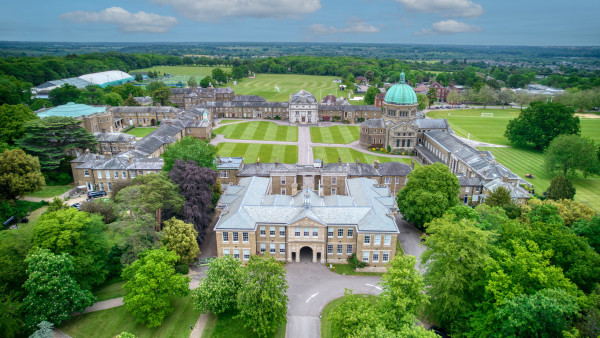
Founded as a post-dissolution grammar school in 1555 by Sir John Gresham on a 200-acre site on the edge of Holt, a fashionable market town. Rejuvenated in the early 20th century by the headmaster George Howson, a person considered to have ‘advanced’ views including a ban on corporal punishment (notable at the time) and the encouragement of pacifist thinking. With space to spread, the school occupies buildings of extraordinary variety ranging from the grand Edwardian Big School through to the contemporary Dyson and Britten buildings, and Auden Theatre – all named for former illustrious pupils. Boarding houses and teaching blocks are scattered around the site, many overlooking the cricket pitch and clubhouse, a quintessentially English scene, helped by the presence of so many dogs.
Large well-stocked library with galleried study area for sixth form and so generous a quantity of books that there are overflow shelves in the corridor outside. The TIGS café in the Britten building is a popular addition – another space for sixth formers to meet and work informally. Former pupils include those famous in the arts and broadcasting such as Lord Reith, founder of the BBC, Benjamin Britten, WH Auden and Olivia Colman; those from the world of technology and science such as Sir Christopher Cockerell (hovercraft), Sir James Dyson and Prof Alan Hodgkin (Nobel prize-winner in physiology and biophysics); and sport, including Tom and Ben Youngs (international rugby players).
Founded in
Large well-stocked library with galleried study area for sixth form and so generous a quantity of books that there are overflow shelves in the corridor outside

Pastoral care, inclusivity & discipline
All speak of the warm relationships and family atmosphere with particular praise for the way older pupils form bonds with younger pupils, especially in the houses. ‘There’s no silly nonsense about other years not speaking to you or hierarchies,’ a parent commented. Mentoring of younger pupils comes naturally in the informal settings of the house, sport and social events, while year 13s can offer a more trained listening ear as mental health first-aiders. House staff keep a close eye on any pupils under pressure or who may be struggling emotionally and there are two full-time mental health nurses to whom pupils can self-refer. There is a pupil-led society ‘celebrating diversity at Gresham’s’ and the school hosts its own Pride week. Parents support the way ‘the school encourages individuality. There is no identikit model pupil but a strong ethos of hard work, kindness and honesty.’ Few discipline problems as staff are regarded as firm and fair with detentions the most common punishment. Occasional miscreants (a handful most years) face suspension for drugs, vaping and smoking, but head says, ‘We believe in forgiveness and second chances.’

Mobile phone policy
A clear mobile phone policy is a really important part of modern schooling. This school has provided us with their policy.
Mobile phone policy
 Provided by the school and not part of our review
 Phones may never be seen around school or in a classroom without permission given by a member of staff. Phones which are used around the site will be confiscated. If effort or achievement in academic or co-curricular activities becomes a concern it is likely that any/all devices may be confiscated for a period of time at the discretion of the HSM. Unacceptable use of mobile phones is covered in the ICT acceptable use policy which pupils must sign. Outside of the permitted times, pupils maybe allowed to contact home by agreement with the HSM. For pupils who have families living in different time zones, the mobile device rules will not prevent access to home.

Pupils & parents
Traditional north Norfolk base has greatly expanded in recent years: ‘Parents pass several good schools to reach Gresham’s,’ says the head. ‘There was talk in the Covid era of London families relocating; there were some, but not as many as numbers now coming from Cambridge and Suffolk.’ A weekly bus service is laid on for this expanding cohort. Parents speak highly of day/boarder relationships and often choose the school as it suits different siblings. Professional, business and creative families, around 20 per cent international, mostly European (IB a natural draw) and parents welcome this dimension as it ‘prevents any Norfolk insularity’. Pupils polite, friendly, unpretentious and very active.

Money matters
Thanks to long association with Worshipful Company of Fishmongers and Gresham’s Foundation, generous scholarships offered in year 9 worth up to 20 per cent of fees with top-up means-tested bursaries available. Awards available for academic excellence, drama, sport, music and art also worth 20 per cent of fees (‘It’s not just a badge of honour,’ said a parent). Sixth form scholarships also available plus usual sibling discounts for three or more. Assistance for families who fall on hard times to get pupils through to public exams.
- Fee information
- Day £25,950 - £26,130; Boarding £36, 360 -50,160 pa

The last word
Near the Norfolk coast, this thriving, happy school with a reputation for encouraging individuality, will suit entire families. Renowned for inspiring creativity, this is a school where sport is just as successful and many are drawn to the flexible sixth form offer. Friendships flourish in a strong house system and excellent leadership inspires confidence. The future looks rosy.